

Windmill-Shaped Ceramic Tuning Fork Enables Ultrasensitive Methane Sensing
News originally published by
EIN Presswire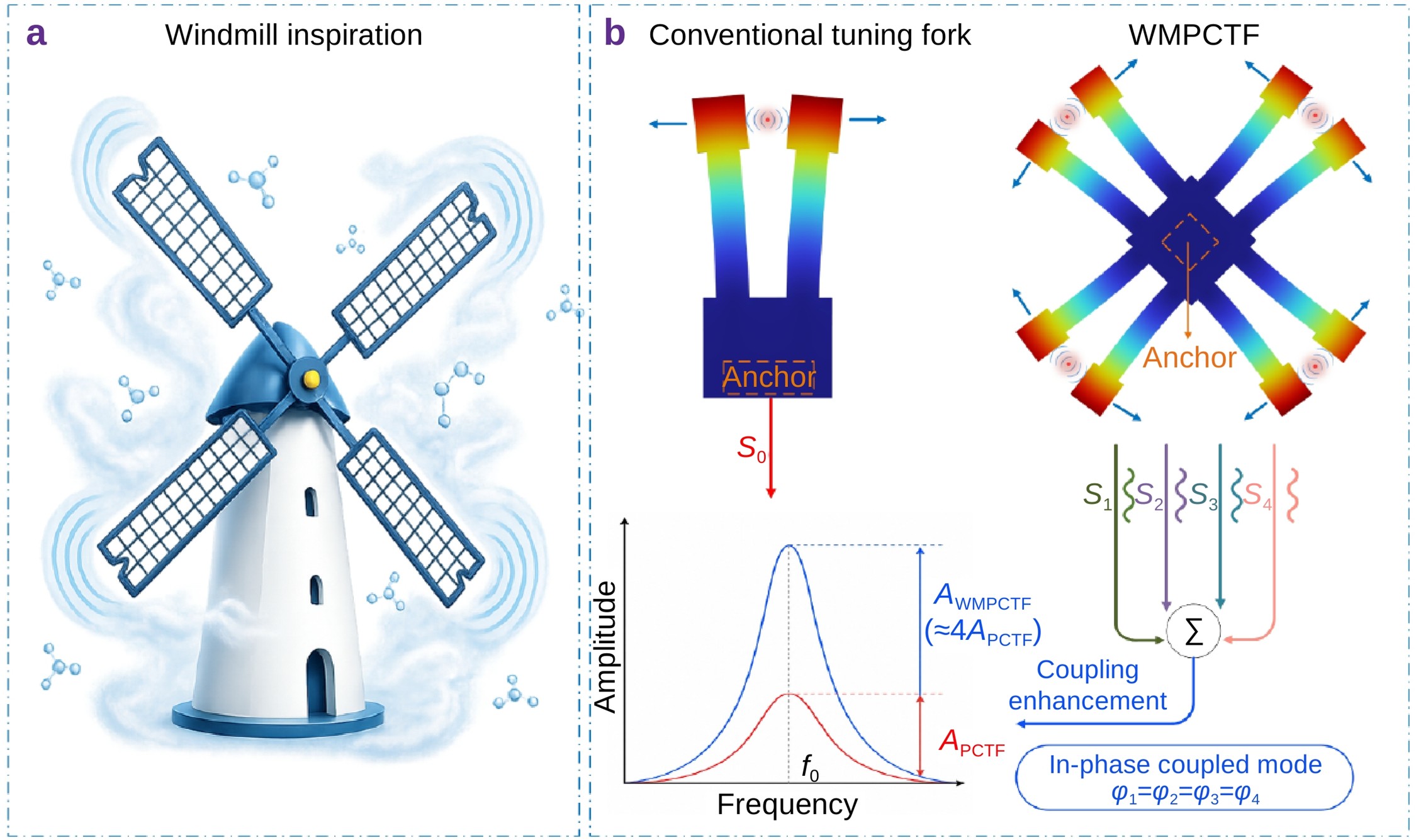
(a) Windmill-inspired fourfold symmetric configuration; (b) comparison between the conventional tuning fork and the proposed WMPCTF, illustrating the superposition of four local piezoelectric responses.
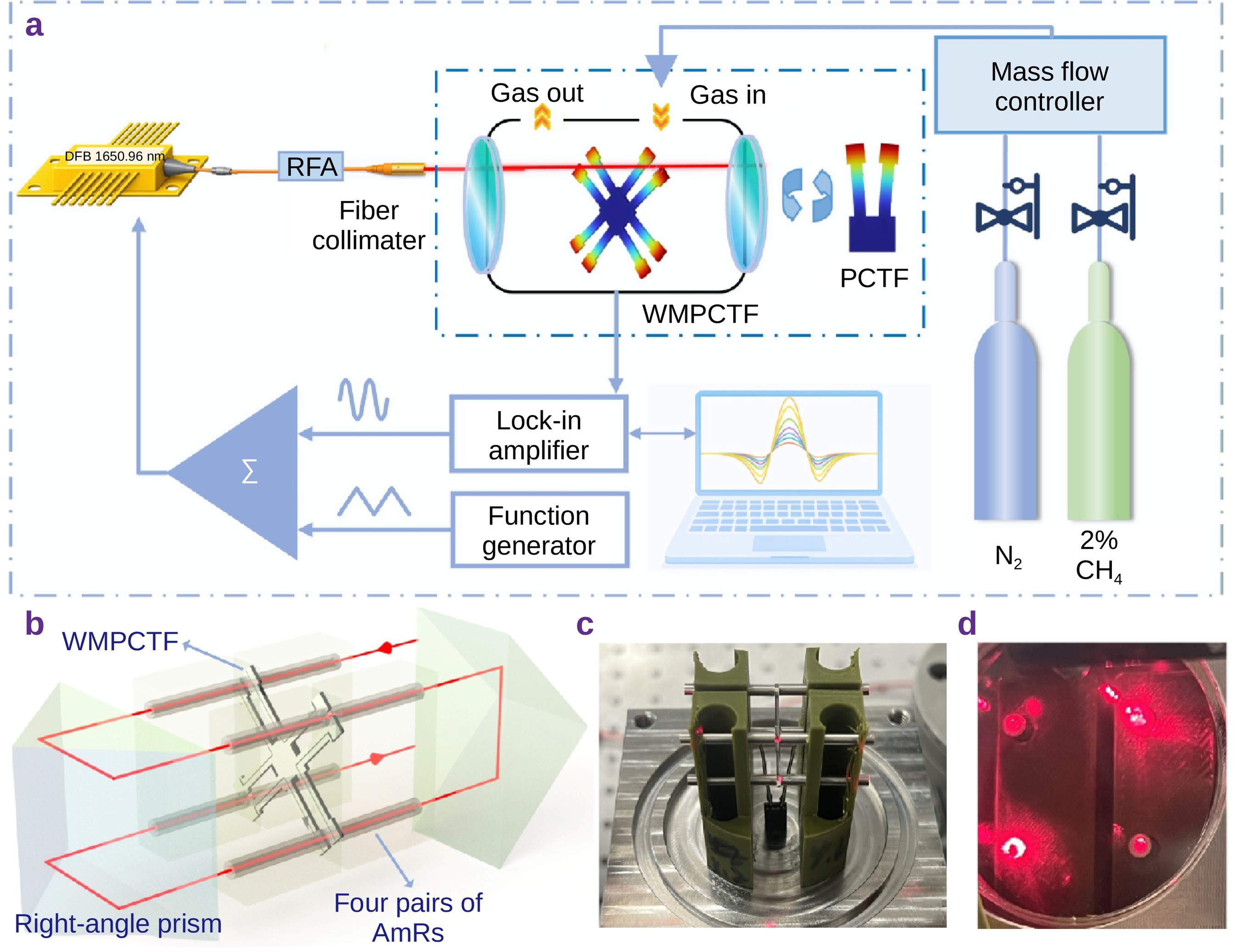
(a) Schematic of the experimental setup; (b) WMPCTF integrated with four pairs of AmRs; (c) photograph of the assembled structure; and (d) laser spot distribution observed through the gas cell. Credit: Research team of Prof. Yufei Ma
Combining multi-unit cooperative piezoelectric transduction, four-pass optical excitation, and acoustic resonance to achieve parts-per-billion detection
CHENGDU, SICHUAN, CHINA, November 6, 2026 /EINPresswire.com/ -- Researchers developed a windmill-shaped multi-unit piezoelectric ceramic tuning fork for sensitive methane photoacoustic sensing. Four coupled local tuning-fork units vibrate synchronously and enable additive piezoelectric charge collection. Combined with a four-pass optical path and four pairs of acoustic microresonators, the system achieves signal and signal-to-noise ratio enhancement factors of about 453 and 394, respectively. With 300 mW excitation, it reaches a 19 ppb detection limit, while Allan deviation indicates 0.87 ppb at 760 s.Trace gas detection is important for environmental monitoring, industrial safety, energy management, and atmospheric chemistry. Methane is both a valuable energy resource and one of the major greenhouse gases. Leakage during production, transport, and storage can contribute to climate change, waste energy, and create safety risks. Laser spectroscopy enables selective gas detection by exploiting the characteristic “fingerprint” absorption properties of gas molecules.
Quartz-enhanced photoacoustic spectroscopy uses a quartz tuning fork to detect acoustic waves generated by the photoacoustic effect. Specifically, gas molecules absorb modulated laser radiation and generate acoustic waves, which drive a quartz tuning fork. The resulting mechanical vibration is then converted into an electrical signal through the piezoelectric effect. The compact dimensions, narrow-band response, and strong rejection of environmental acoustic noise make the tuning fork an effective resonant detector. However, quartz has a relatively low piezoelectric coefficient, and its crystallographic anisotropy restricts structural design freedom. A conventional tuning fork also relies mainly on one local pair of prongs for acoustic interaction. Expanding the effective interaction area and improving piezoelectric conversion while retaining compact resonant readout therefore remain important goals for advancing tuning-fork photoacoustic sensing.
To address the weak piezoelectric response, crystallographic orientation dependence, and limited structural design freedom of conventional quartz tuning forks, the research team led by Professor Yufei Ma at Harbin Institute of Technology, together with collaborators from the Institute of Semiconductors, Chinese Academy of Sciences, and Politecnico di Bari, introduced for the first time a windmill-shaped multi-unit piezoelectric ceramic tuning fork (WMPCTF) for highly sensitive methane detection based on piezoelectric ceramic-enhanced photoacoustic spectroscopy. The work, entitled “Windmill-shaped multi-unit piezoelectric ceramic tuning fork for cooperatively enhanced photoacoustic methane sensing,” was made available online on October 21, 2026, and published in Volume 5, Issue 10 of the journal Opto-Electronic Science.
Compared with quartz, piezoelectric ceramics have much higher piezoelectric coefficients and can produce stronger charge responses under the same mechanical excitation. More importantly, a thickness-poled polycrystalline piezoelectric ceramic exhibits approximately equivalent macroscopic electromechanical responses along two orthogonal in-plane directions. Tuning-fork units extending in different directions can therefore use the same poling and electrode configurations, providing greater freedom for multi-directional and multi-unit structures.
Using this material property, the researchers designed a windmill-shaped device containing four local tuning-fork units arranged with fourfold symmetry. The units are mechanically coupled through a common central region and vibrate synchronously in the target in-plane mode, allowing their piezoelectric charge outputs to be collected additively. Finite-element simulations showed that the WMPCTF generated a total absolute surface charge of 118.5 nC under the specified excitation, compared with 31.5 nC for a conventional piezoelectric ceramic tuning fork, corresponding to a 3.76-fold increase.
The four local units were further combined with a folded four-pass optical path and four pairs of optimized acoustic microresonators (AmRs), so that each unit received enhanced photoacoustic excitation. Relative to the one-pass WMPCTF configuration without AmRs, the complete system achieved signal and signal-to-noise ratio enhancement factors of about 453 and 394, respectively. At an excitation power of 300 mW, the methane detection limit reached 19 ppb. Allan deviation analysis showed that the minimum detectable concentration reached 0.87 ppb at an integration time of approximately 760 s.
By translating the high piezoelectric response and approximately equivalent in-plane behavior of piezoelectric ceramics into a cooperatively coupled multi-unit architecture, this work links material selection, resonator geometry, multi-pass optical excitation, and acoustic resonance. The strategy provides a new route for designing complex tuning-fork photoacoustic transducers with stronger electromechanical conversion and improved trace gas detection capability.
***
Reference
Title of original paper: Windmill-shaped multi-unit piezoelectric ceramic tuning fork for cooperatively enhanced photoacoustic methane sensing
Journal: Opto-Electronic Science
DOI: 10.29026/oes.2026.260068
About Opto-Electronic Science
Opto-Electronic Science (OES) is a premier, open-access, peer-reviewed journal boasting an impressive Impact Factor and CiteScore. Indexed in major databases like Scopus, ESCI, DOAJ, and CA, OES serves as a leading platform for academic exchange and innovation in optics and optoelectronics. The journal publishes high-impact articles, reviews, and letters spanning diverse fields—such as quantum optics, ultrafast optics, micro/nano optics, biophotonics, and integrated optics. Headquartered in Chengdu, China, OES bridges fundamental scientific breakthroughs with cutting-edge technological advancements in the global research community.
Website: https://www.oejournal.org/oes/
About Botao Liu from Harbin Institute of Technology
Botao Liu is a PhD candidate in Electronic Information at Harbin Institute of Technology. His research focuses on laser-spectroscopic gas sensing and novel piezoelectric resonators. His work includes piezoelectric ceramic tuning forks, bioinspired asymmetric lithium niobate tuning forks, and coupled multi-unit tuning forks for trace-gas detection. His research has been published in Laser & Photonics Reviews, Analytical Chemistry, and Photonics Research.
About Professor Yufei Ma from Harbin Institute of Technology
Yufei Ma is a professor at the School of Astronautics, Harbin Institute of Technology, and an Optica Fellow. His research focuses on optoelectronic sensing. He has led projects supported by the Key Program and Excellent Young Scientists Fund of the National Natural Science Foundation of China, pre-research projects for China’s manned space program, and technology projects commissioned by Huawei. He serves as an Area Editor, Associate Editor, or Editorial Board Member for several SCI journals. He was named an Elsevier Highly Cited Chinese Researcher from 2021 to 2025 and has published more than 100 papers.
Funding information
This work was supported by the National Natural Science Foundation of China (Grant Nos. 62335006, 62275065, 625B2063, 624B2050, 62405078, and 62505066), Natural Science Foundation of Heilongjiang Province (Grant Nos. BS2025F002 and LH2024F031), Heilongjiang Postdoctoral Fund (Grant Nos. LBH-Z23144 and LBH-Z24155), China Postdoctoral Science Foundation (Grant No. 2024M764172), Open Subject of Hebei Key Laboratory of Advanced Laser Technology and Equipment (HBKL-ALTE2025001), and the Fundamental Research Funds for the Central Universities (HIT.DZJJ.2025015 and HIT.NSFJG202463).
Siyi Ma
Institute of Optics and Electronics, CAS
+86 19136186296
oej_publishing@ioe.ac.cn
Legal Disclaimer:
EIN Presswire provides this news content "as is" without warranty of any kind. We do not accept any responsibility or liability for the accuracy, content, images, videos, licenses, completeness, legality, or reliability of the information contained in this article. If you have any complaints or copyright issues related to this article, kindly contact the author above.
